Our Services
Treatment
An overview of the treatments available at Igarashi Dental Clinic
First Visit
We see patients by appointment, but first-time visits are welcome at any time.
At your first visit, we take dental X-rays and examine the overall condition of your teeth and gums.
We then perform your first scaling (dental cleaning).
The cost varies slightly depending on the number of teeth involved, but with a 30% co-payment it comes to around ¥3,000.
If your co-payment rate is 10%, please divide the amounts below by three.
If you are not in pain, treatment will begin after scaling.
However, for patients with acute symptoms, even at the first visit we begin by relieving the pain first.
Wisdom Tooth Pain
The fee under National Health Insurance varies depending on how the tooth is positioned, but the process involves taking an X-ray, administering anesthesia, extracting the tooth, and issuing a prescription, for a total in the range of ¥2,500–¥4,500.
Root Canal Treatment for a Cavity
The cost varies depending on whether the nerve is still alive (requiring anesthesia) or already dead, and whether the tooth is a front tooth or a molar, but the process generally starts by opening the root canal to relieve the pain, then issuing a prescription, for a total in the range of ¥4,000–¥5,000.
Gum Swelling and Pain
We administer anesthesia and then perform scaling. If pus has accumulated, we drain as much as possible, apply antibiotics to the area, and issue a prescription, for a total of around ¥3,500.
Insurance-Covered Treatment
When You Have a Cavity That May Be Sensitive but Does Not Require Nerve Removal
The fee under National Health Insurance varies depending on how the tooth is positioned, but the process involves taking an X-ray, administering anesthesia, extracting the tooth, and issuing a prescription, for a total in the range of ¥2,500–¥4,500.
When a Painful Cavity Requires Root Canal Treatment
• For Molars
We administer anesthesia as needed and remove the softened dentin (the decayed part of the tooth, commonly known as a cavity). After disinfecting the area, we cover it with cement and check on the healing; if there is no pain, we then shape the tooth, take an impression, fabricate a restoration suited to the extent of the defect, set it in place, and adjust the bite. We carefully fit and polish the border between the metal restoration and the tooth to help prevent decay from developing underneath the metal. A partial metal restoration (inlay) costs ¥1,500–¥3,000, while a restoration covering all or most of the tooth (onlay or crown) costs around ¥3,000–¥5,000.
• For Front Teeth
The process up to removing the softened dentin is the same, but because front teeth are visible, we fill the area with composite resin matched to the shade of your tooth. On request, we can also make the shade a little whiter. This costs ¥700–¥1,000 per tooth.
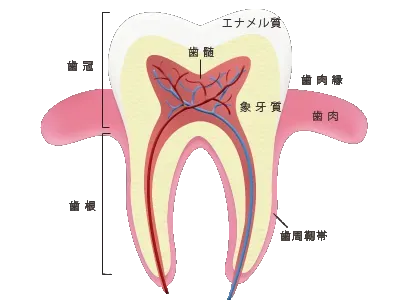
The diagram is labeled in Japanese: 歯冠 (crown), 歯根 (root), エナメル質 (enamel), 象牙質 (dentin), 歯髄 (pulp), 歯肉 (gum), 歯周靱帯 (periodontal ligament).
When a Large Cavity Is Sensitive to Hot Food or Drink and Causes Throbbing Pain
In the former case, the nerve is still alive, so after administering anesthesia we remove the pulp. In the latter case, the tooth is dead, so we do not administer anesthesia; however, if earlier treatment was incomplete and tissue at the root tip is still alive, we administer anesthesia and either open the canal all the way to the tip, or place an antibacterial medication and open it at your next visit.
Root canal treatment is a battle against bacteria. The softened dentin in the tooth is a layer of bacteria, so it must be removed completely. The same is true when there is old filling material inside the root canal.
Because this work takes place somewhere we cannot see, it takes longer than you might expect, and the goal is to sterilize the inside of the root canal. During treatment, we make and fit a plastic temporary crown, taking your appearance and bite into consideration. On average, root canal treatment takes about 4–5 visits.
About Choosing a Restoration (Crown)
At the temporary crown stage, we do a rough shaping of the tooth so that a core or post (a reinforcement placed inside the root canal) will fit easily. After the root canal is filled, we shape the tooth again and take an impression for the core.
Silver alloy is used for most of these, but for lower front teeth, where the post is thin, we use a palladium alloy to help prevent fracture.
In addition, if the front (labial) edge of the root canal is chipped due to bite forces or teeth grinding, we use a glass fiber post.
These are all within the scope of National Health Insurance. For front teeth we provide rigid resin-faced crowns, and for premolars, resin jacket crowns.
In practice, however, these are made using Gradia (a hybrid ceramic material) at our partner dental laboratory. As an exception, this is not possible for patients with a strong bite, or for teeth that will support a denture clasp.
For molars as well, the NHI-covered crown is a palladium alloy crown. The cost of placing the post is about ¥3,000 for front teeth and about ¥1,500 for molars. When the permanent crown is set in place, a rigid resin-faced crown costs just under ¥7,000, and a palladium alloy crown costs a little over ¥4,000 to a little over ¥5,000.
Private Treatment
When the Cavity Is Not Large and Needs Only Partial Coverage (Inlay Type)
The material used depends on the shape of the restoration, but the options are hybrid ceramic (Gradia) and ceramic (e.max).
Gradia is a hard plastic material with a good color match, but it does absorb some water.
e.max does not absorb water and is even harder than Gradia.
Gradia: ¥30,000 (excl. tax)
e.max: ¥40,000 (excl. tax)
When Matching the Color of Your Teeth Instead of Using Metal
We use ceramic (metal-bonded — porcelain fused onto a metal base), or all-ceramic (zirconia-bonded).
Metal-bonded crown: ¥40,000 (excl. tax)
Zirconia-bonded crown: ¥60,000 (excl. tax)
For a Bridge
The cost is the per-tooth fee above multiplied by the number of teeth in the bridge.
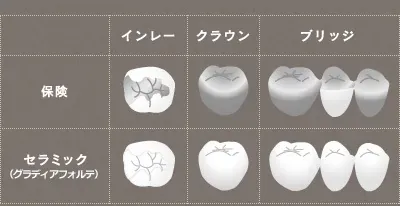
The diagram is labeled in Japanese: インレー (inlay), クラウン (crown), ブリッジ (bridge), 保険 (insurance-covered), セラミック・グラディアフォルテ (ceramic / Gradia Forte).
For Metal-Base Dentures (Cobalt-Chrome Base)
The cost varies depending on the number of missing teeth and the number of appliances required.
One arch (upper or lower): ¥150,000–¥300,000 (excl. tax)
Both arches (full mouth): ¥200,000–¥400,000 (excl. tax)
The price difference depends on the dental laboratory and the materials used. We also make dentures using other materials.
For Magfit Attachments
When a tooth is not strong enough on its own, we use a magnet (Magfit) as part of the support for the denture.
¥50,000 per appliance (excl. tax)
For whitening, we take an impression of your teeth to make a custom mouthpiece, then perform about one hour of whitening treatment at the clinic, for ¥30,000 (excl. tax).
For private (self-pay) treatment, we provide an overall cost estimate in advance, so treatment can be tailored to fit your budget.
Pain-Minimized Treatment
Two common reasons people dislike going to the dentist are the sound of the drill when cutting teeth, and pain during treatment. The former has been greatly reduced thanks to improved drills.
As for pain, when treatment is limited to the enamel, you will feel little to no pain, but if you feel anxious, we can administer anesthesia.
For more extensive drilling, nerve removal, or tooth extraction, we of course administer anesthesia, and we also take care to minimize the pain of the injection itself.
First, we apply a topical anesthetic with a cotton pellet at the injection site to reduce the initial sharp pinch of the needle. This helps prevent your pain threshold from dropping.
Next, when inserting the needle into the mucous membrane, we gently hold your lip and draw it toward the needle, which makes the sensation harder to notice. The anesthetic solution is kept at body temperature to prevent pain caused by coldness.
Finally, we inject the anesthetic slowly to prevent pain caused by pressure on the mucous membrane. When a wider area needs treatment, we give a series of injections to keep discomfort to a minimum.
Most patients feel almost nothing during the injection, and only a small number report any pain.
For this reason, we carry out pain-minimized treatment with the utmost care.